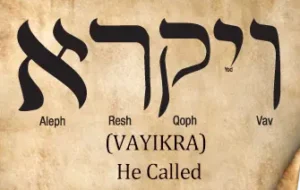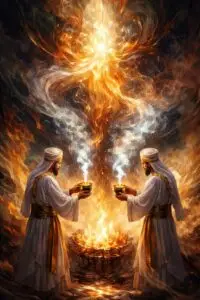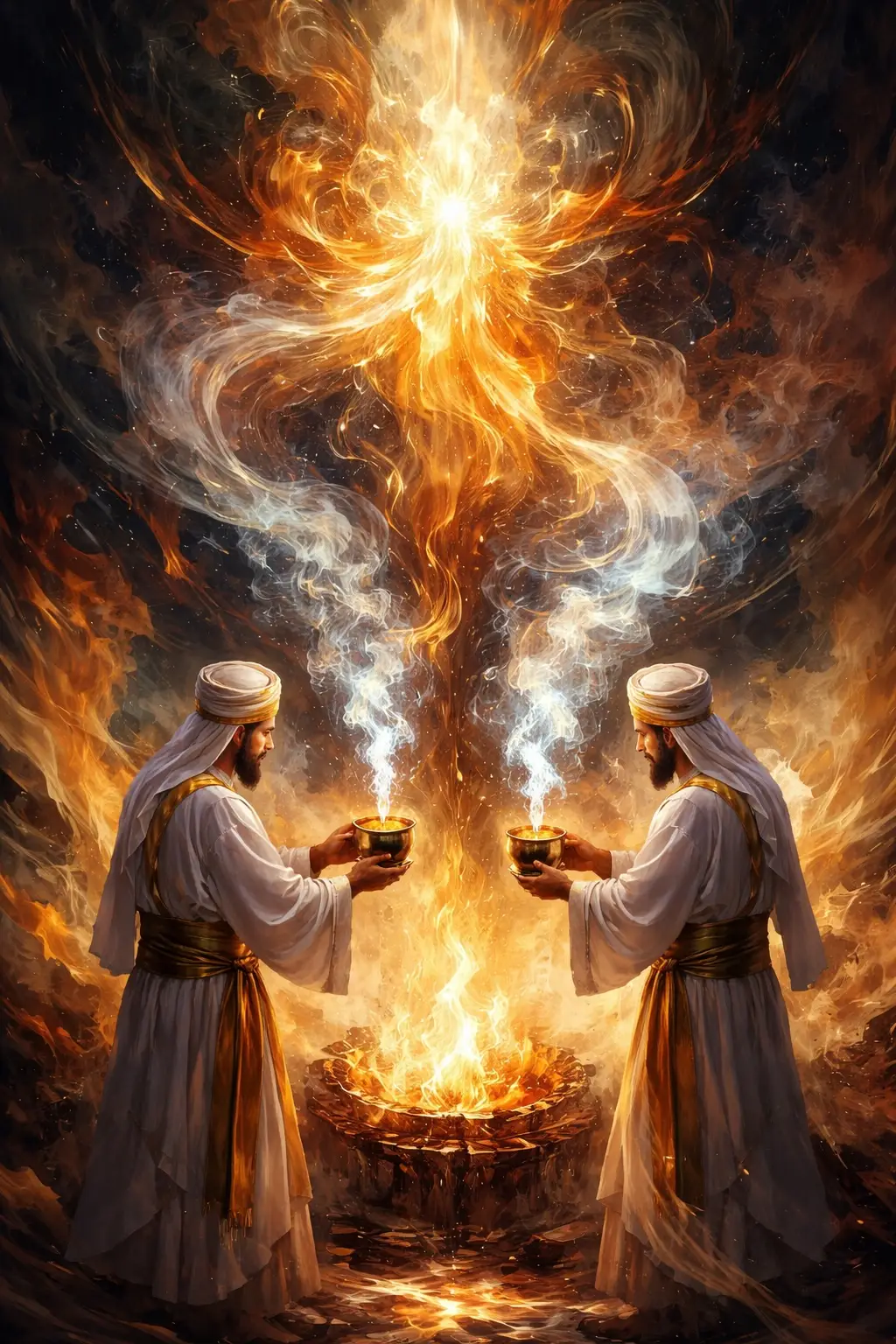
Vayikra records the account of Nadab and Abihu, the elder sons of Aaron, who—deviating from prescribed ritual—are struck down:
“Now Aaron’s sons Nadab and Abihu each took his fire pan, put fire in it, and laid incense on it; and they offered before the Lord alien fire, which He had not authorized them. And fire came forth from the Lord and consumed them; and they died before the Lord.”
(Leviticus 10:1–2)
The severity of the punishment is striking. What exactly was their transgression, and why does it warrant such immediate destruction? The episode also unsettles widely held descriptions of God as patient, merciful, and forgiving.
But perhaps the more immediate question for the modern reader is simpler: Why should this matter to us at all? Why devote attention to a story that seems distant, obscure, and morally troubling?
The answer may be that these questions themselves are the point.
To question—to ask, to challenge, to refuse easy coherence—is not incidental to Judaism. It is one of its defining intellectual habits. Jewish literature does not merely transmit conclusions; it trains the mind in a particular discipline: to interrogate, to revisit, to reopen.
In this sense, asking why such a story exists, why it has been preserved, and what it demands of us today is itself a form of Jewish engagement.
Yet questioning alone is not sufficient. Answers are always attempted. Each generation produces its own interpretations—and those interpretations often reveal more about the generation that produces them than about the original event. They reflect its anxieties, its structures of authority, its moral sensitivities.
If we turn to some of the earliest interpretive directions, a different layer of the text begins to emerge.
Although Nadab and Abihu are introduced here as Aaron’s sons, their names appear elsewhere in the TaNaKh in ways that are not consistently tied to that lineage. Strikingly, their names echo those of the sons of Jeroboam, the king associated with the establishment of the Bethel cult—an alternative religious center in Israel. Jeroboam’s sons, too, die prematurely.
This parallel has led some scholars to suggest that the story may contain a veiled polemic. Rather than a simple account of ritual error, it may reflect internal struggles within ancient Israel—conflicts between priestly groups, competing claims to authority, and efforts to delegitimize rival traditions.
In that light, the narrative takes on a different character. “Divine judgment” may function less as a theological statement and more as a means of establishing legitimacy. The invocation of God becomes a way of stabilizing human claims within a contested historical reality.
This possibility is not foreign to human experience. Again and again, individuals and groups appeal to God to justify actions that are, in fact, rooted in human interests, conflicts, and structures of power.
If so, then the text is not simply about God. It is about the persistent human tendency to speak in God’s name.
And this returns us to the central insight: what matters is not only what the text says, but how it trains us to read.
A Jewish way of thinking does not accept the surface as final. It asks: What is being claimed? Who is speaking? What is at stake? What lies behind the invocation of authority?
The story of Nadab and Abihu endures not because it resolves these questions, but because it refuses to let them disappear.
And that refusal—to keep the question open—is itself one of Judaism’s most enduring intellectual acts.