Judaism and Artificial Intelligence
A philosophical and ethical inquiry into one of the defining challenges of the 21st century: how human responsibility survives in a world increasingly shaped by autonomous systems, algorithmic decision-making, and machine intelligence.
21ST CENTURY
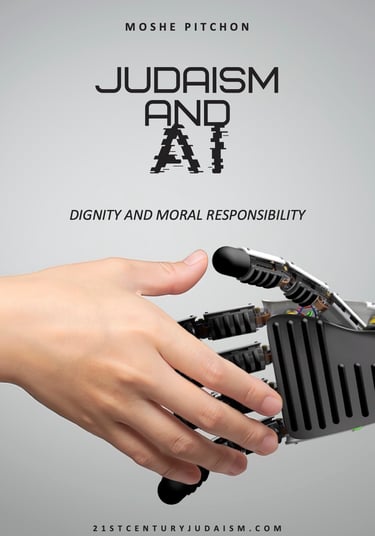
Artificial intelligence is commonly treated as a problem of regulation, safety, or alignment. Judaism and Artificial Intelligence argues that this framing misses the deeper issue. AI is not only a technological disruption—it is a moral one.
By accelerating decision-making, automating recommendation, and dispersing agency across systems that cannot answer for their actions, AI undermines the human capacity to interrupt action and take responsibility.
Judaism does not ground moral life in abstract rules or technological mastery, but in answerability—the obligation of human beings to respond, judge, and take responsibility for the consequences of their actions, even under conditions of uncertainty, power, and historical change.
Rabbi Pitchon explores how AI challenges core moral categories:
– responsibility without clear authorship
– power without direct intention
– speed without judgment
– desire shaped before reflection
– regulation without moral ownership
This is nt an argument against innovation, nor a proposition to retreat into nostalgia. Instead, it is a call for a renewed understanding of what it means to be human in an age of intelligent systems—one grounded in responsibility, judgment, and moral courage.